For years, the playbook for building an artificial intelligence capability was simple: hire data scientists. Companies rushed to recruit top math PhDs and statistical modelers, expecting them to magically transform raw data into transformative business value.
While data scientists remain crucial for research, algorithm design, and statistical validation, relying solely on them to build production-ready AI products has led to a major bottleneck. Many organizations find that their state-of-the-art models never make it out of Jupyter notebooks, or they fail spectacularly when subjected to real-world user traffic, security vulnerabilities, and latency requirements.
The reality of modern AI development has shifted. Moving from experimental machine learning to scalable, production-grade AI applications requires a diverse, multi-disciplinary engineering organization. To build robust AI products, companies must look beyond the traditional data science role and assemble a specialized AI engineering team.
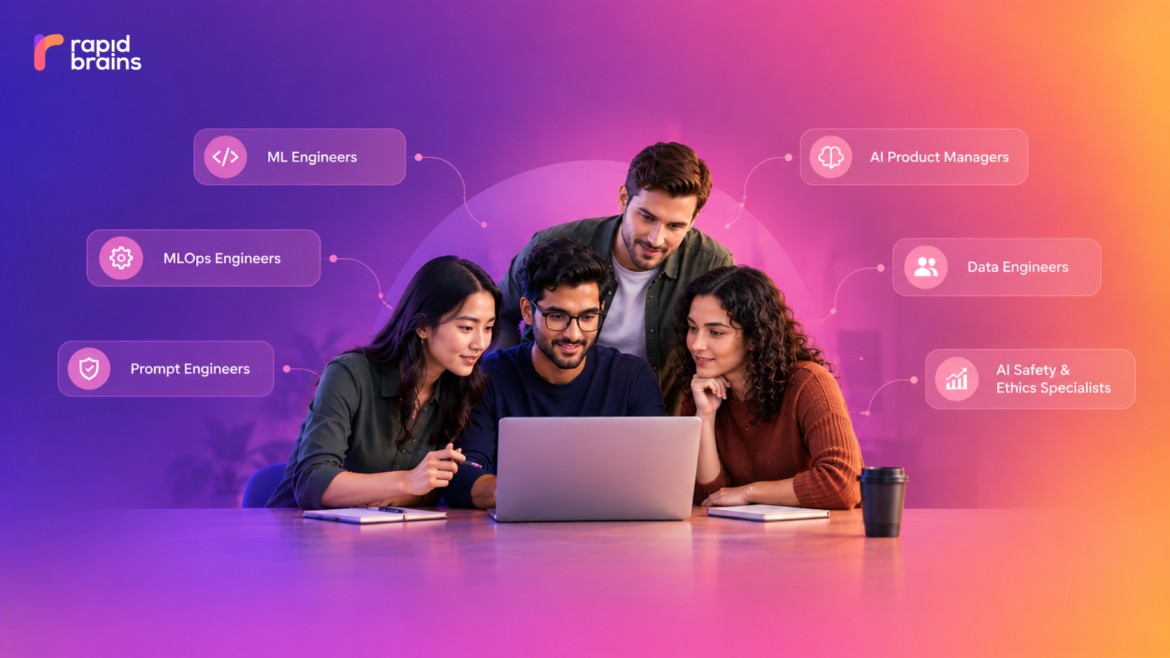
Here is a breakdown of the critical roles required for a modern, fully functioning AI team, and how each contributes to delivering real business impact.
The Essential Roles in a Modern AI Engineering Organization
1. AI Systems Engineers / MLOps Engineers
Building a model is only a fraction of the challenge; deploying, monitoring, and maintaining it at scale is where most of the operational heavy lifting occurs. Machine Learning Operations (MLOps) engineers bridge the gap between model creation and production deployment.
MLOps engineers design automated pipelines for continuous integration, deployment, training, and testing (CI/CD/CT). They handle infra-as-code, manage compute clusters, optimize latency, and build monitoring systems to catch model drift, data degradation, and system failures in real time. Without strong MLOps practices, an AI team spends most of its time manually fixing broken pipelines rather than delivering new features.
2. Data Engineers and AI Pipeline Architects
An AI model is only as reliable as the pipeline feeding it. While data scientists analyze data, data engineers build the robust, scalable infrastructure required to collect, clean, aggregate, and deliver massive datasets in real time or batch modes.
In the era of Generative AI and Large Language Models (LLMs), data engineering has expanded to include managing vector databases, embedding pipelines, and unstructured data ingestion. Data engineers ensure high data quality, pipeline stability, low latency, and compliance with data governance standards, providing the foundation for every model performance metric.
3. Prompt Engineers and AI Context Designers
With the rise of foundation models and Generative AI, a new discipline has emerged around guiding AI behavior without retraining underlying weights. Prompt engineers and context designers focus on optimizing inputs, crafting structured system prompts, and designing Retrieval-Augmented Generation (RAG) contexts.
These specialists work closely with domain experts to ensure the AI responds accurately, maintains the correct tone, adheres to strict safety guidelines, and minimizes hallucinations. They test edge cases, systematically evaluate output quality, and fine-tune system instructions to maximize model accuracy and reliability.
4. AI Product Managers
Building an AI feature is fundamentally different from traditional software product development. AI products are probabilistic rather than deterministic; they do not always yield the exact same output for a given input.
An AI Product Manager understands these unique dynamics. They translate complex business objectives into achievable technical requirements, manage uncertainty, define metrics for acceptable accuracy versus speed, and guide user experience expectations. They act as the vital bridge between business stakeholders, UI/UX designers, and deep technical engineers.
5. AI Security and Compliance Specialists
AI introduces entirely new attack vectors, such as prompt injection, data poisoning, model inversion attacks, and training data extraction. Furthermore, global regulations surrounding algorithmic privacy, bias, and copyright compliance are evolving rapidly.
AI Security and Compliance Specialists work to secure the entire machine learning lifecycle. They perform red-teaming exercises on models, ensure data privacy through techniques like differential privacy, audit outputs for harmful bias, and guarantee that AI deployments align with regulatory standards like the EU AI Act and HIPAA.
The Cost of a Missing Strategy: Why Balancing Your AI Team Matters
When a company fills its AI department exclusively with data scientists, several operational problems consistently occur:
- Deployment Stagnation: Models remain as prototypes because no one on the team specializes in backend integration, microservices, or cloud infrastructure.
- Uncontrolled Costs: Without infrastructure optimization, cloud compute bills for model training and inference can skyrocket unexpectedly.
- Low Reliability: Lack of automated monitoring means model drift goes unnoticed until customers report degraded product performance.
- Slower Time-to-Market: Data scientists end up spending 80% of their time on engineering infrastructure and pipeline maintenance, areas outside their core expertise.
To maintain a competitive edge, companies must shift from a model-centric mindset to a software systems mindset.
How RapidBrains Helps You Build and Scale the Right AI Engineering Team
Assembling a balanced, multi-disciplinary AI team requires speed, deep domain insight, and access to top global technical talent. Finding specialized MLOps engineers, vector database architects, or AI security experts in local markets can take months, delaying critical project timelines and increasing recruitment overhead.
This is where RapidBrains transforms your AI roadmap into reality.
RapidBrains specializes in matching companies with pre-screened, elite technical talent across the entire software and AI spectrum. Rather than offering generic development resources, RapidBrains understands the nuanced roles required for modern AI deployment.
1. Precision Role Matching
Whether you need an MLOps architect to stabilize your inference pipeline, a data engineer to set up a real-time vector database, or an AI Product Manager to lead your Generative AI transition, RapidBrains source developers tailored to your specific tech stack and architectural needs.
2. Rapid Onboarding and Scaling
AI moves too fast for traditional 90-day hiring cycles. RapidBrains enables you to onboard pre-vetted AI specialists in as little as 24 to 48 hours. This agility allows organizations to scale up specialized capabilities during intense development phases and optimize costs as projects mature.
3. Rigorous Quality Vetting
Every engineer in the RapidBrains network undergoes strict technical, communication, and problem-solving assessments. This ensures that the professionals joining your team possess proven hands-on experience in building, securing, and maintaining production AI systems.
4. Seamless Integration and Flexibility
Engineers sourced through RapidBrains integrate directly into your existing workflows, agile practices, and toolchains. You maintain complete control over project management and technical architecture, while RapidBrains handles candidate sourcing, contract management, and operational logistics.
The era of relying solely on data scientists to drive an enterprise AI strategy is over. Successful AI deployment demands a cohesive team composed of system engineers, data architects, prompt specialists, product leaders, and security experts working in sync.
By expanding your hiring vision beyond traditional roles, you can build resilient, scalable AI applications that deliver immediate commercial value. Partnering with RapidBrains ensures you get the exact expertise required to construct your high-performing AI engineering team quickly, efficiently, and at scale.