Implementing, maintaining, or upgrading an Enterprise Resource Planning (ERP) ecosystem like SAP is one of the most capital-intensive and strategically vital investments a modern business can make. Because SAP serves as the operational central nervous system for everything from global supply chain logistics to real-time financial reporting, choosing the right software architecture is only half the battle. The other, and often more complex, half is deciding who will build, configure, and maintain it.
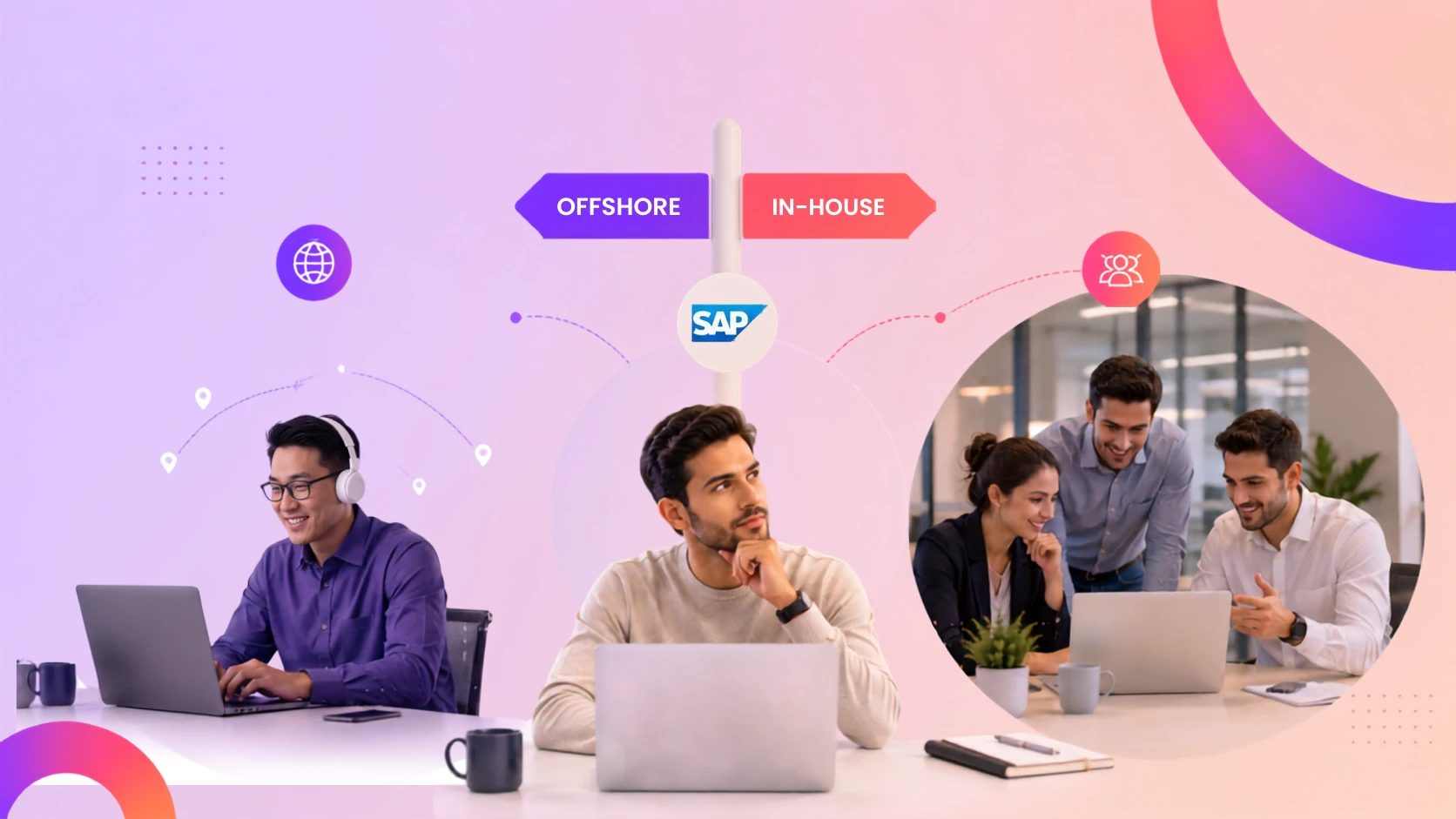
When mapping out your digital transformation roadmap, you will inevitably face a critical operational pivot point: Should you invest heavily in building a permanent in-house SAP team, or should you partner with offshore SAP consultants?
There isn’t a single, universally correct answer. Choosing the wrong talent model can result in blown IT budgets, missed migration deadlines, or severe operational bottlenecks. To help you navigate this decision, let’s explore the deep mechanics of both approaches and identify exactly when to choose one over the other.
The In-House SAP Team: Long-Term Stability & Deep Domain Knowledge
An in-house SAP team consists of full-time employees, such as Basis engineers, ABAP developers, and functional consultants, dedicated solely to your enterprise. This model treats SAP competency as a permanent, core capability of the company.
When to Choose an In-House Team:
- Core Business Continuity & Zero-Risk Tolerance: If SAP is the absolute lifeblood of your daily operations, such as in a massive, high-throughput manufacturing facility where 10 minutes of system downtime translates to millions of dollars in lost revenue, having an immediate, on-site team to troubleshoot critical failures is invaluable.
- Deep Institutional Process Intimacy: Internal teams live and breathe your corporate culture, regulatory environment, and unique operational quirks. Over time, they develop a profound understanding of why legacy systems were configured in a certain way, which is an attribute that external providers rarely replicate.
- A Continuous, High-Volume Product Pipeline: If your corporate roadmap includes a non-stop backlog of internal feature requests, custom proprietary applications, and continuous localized rollouts across dozens of subsidiaries, maintaining a dedicated internal team provides predictability in your development velocity.
The Hidden Downsides:
While stability is a massive benefit, the in-house route is rigid. SAP professionals command some of the highest salaries in the tech industry. When you factor in recruitment fees, health benefits, and the high risk of talent poaching, maintaining a full internal bench becomes an incredibly expensive fixed cost. In fact, data from the ASUG Pulse of the SAP Customer Research continually highlights that the ongoing internal skills gap remains one of the greatest challenges for modern enterprise IT teams. Furthermore, when your system is stable, an entire in-house team may find themselves underutilized, yet their overhead remains completely static.
The Offshore SAP Consultant: Agility, Scale, and Specialized Expertise
Offshore SAP consulting involves partnering with remote experts, specialized agencies, or elastic talent platforms to handle implementations, migrations, support, or custom development. Rather than viewing SAP management as a permanent headcount cost, this model treats it as a scalable, on-demand service.
When to Choose Offshore SAP Consultants:
- Finite Project Milestones (e.g., SAP S/4HANA Migration): Transitioning from legacy ECC systems to SAP S/4HANA or executing a major cloud migration requires an intense, highly specialized surge of talent for a fixed period, typically 6 to 18 months. Hiring full-time staff for a temporary lifecycle event leaves you heavily overstaffed once the system goes live. Offshore consulting allows you to inject elite talent exactly when the workload peaks, and ramp down when it concludes.
- Access to Niche Module Expertise: Your internal team might excel at core modules like FI/CO (Finance/Controlling) or MM (Materials Management), but what happens when the business decides to suddenly deploy SAP IBP (Integrated Business Planning), SuccessFactors, or Ariba? Hiring a full-time expert for a single module rollout is highly inefficient. Offshore partnerships grant you instant access to precise module specialists on an as-needed basis.
- Drastic Cost Optimization: By leveraging global talent pools in regions with lower costs of living, enterprises can reduce their development and maintenance spend by up to 50 to 70 percent. This capital can then be reallocated directly into driving core business innovation rather than just keeping the lights on.
- “Follow-the-Sun” Support Models: For multinational organizations, offshore teams located across varying time zones provide seamless, 24/7 system monitoring and ticketing support. Your offshore partners can handle complex system maintenance, patching, and minor bug fixes while your domestic team sleeps, ensuring zero daytime operational disruption.
Head-to-Head Comparison Matrix
| Decision Metric | In-House SAP Team | Offshore SAP Consultant |
| Financial Structure | High, rigid fixed overhead (Salaries, benefits, real estate) | Flexible, variable operational costs (Pay strictly for utilization) |
| Scalability & Speed | Slow (Requires lengthy hiring, vetting, and onboarding cycles) | Rapid (Instantly scale up or down based on sprint demands) |
| Skill Diversity | Generalized and tailored closely to your existing footprint | Instant access to a massive global pool of niche module experts |
| Onsite Availability | Immediate physical presence for localized crises | Remote-first via structured collaboration and communication tools |
| Retention Risk | High (Internal attrition requires starting the hiring loop over) | Zero (The partner organization manages staffing continuity) |
The Hybrid Reality: Structuring the Perfect Blend
For most scaling enterprises, the choice does not have to be strictly binary. In fact, the most efficient and cost-effective organizations utilize a hybrid model to capture the benefits of both worlds.
Under a hybrid architecture, a company maintains a lean, core in-house team consisting of an SAP Project Manager, an Enterprise Architect, and key functional leads who deeply understand the corporate strategy. This core group owns the business logic and strategic vision. The company then partners with an offshore SAP consulting framework to act as the heavy-lifting engine, handling routine ABAP programming, data migration scripting, continuous testing, and around-the-clock Basis support.
How RapidBrains Accelerates Your SAP Strategy
Navigating the competitive SAP talent landscape independently can derail your timelines before a single line of code is written. At RapidBrains, we eliminate the friction associated with scaling your technical team.
Whether you need a temporary squad of elite ABAP developers to clear a critical product backlog or dedicated offshore functional consultants to guide your enterprise through a complex cloud migration, we connect you with top-tier, pre-vetted SAP professionals. Our talent seamlessly integrates with your existing workflows, giving you the agility of an offshore model with the quality control of an elite internal unit.