Scaling an engineering team across the globe is no longer the exception; it is the norm. The availability of a global talent pool empowers CTOs and VPs of Engineering to assemble great teams at an unprecedented pace. However, integrating remote engineers into a legacy codebase, monolith, or undocumented codebase often creates friction rather than speed.
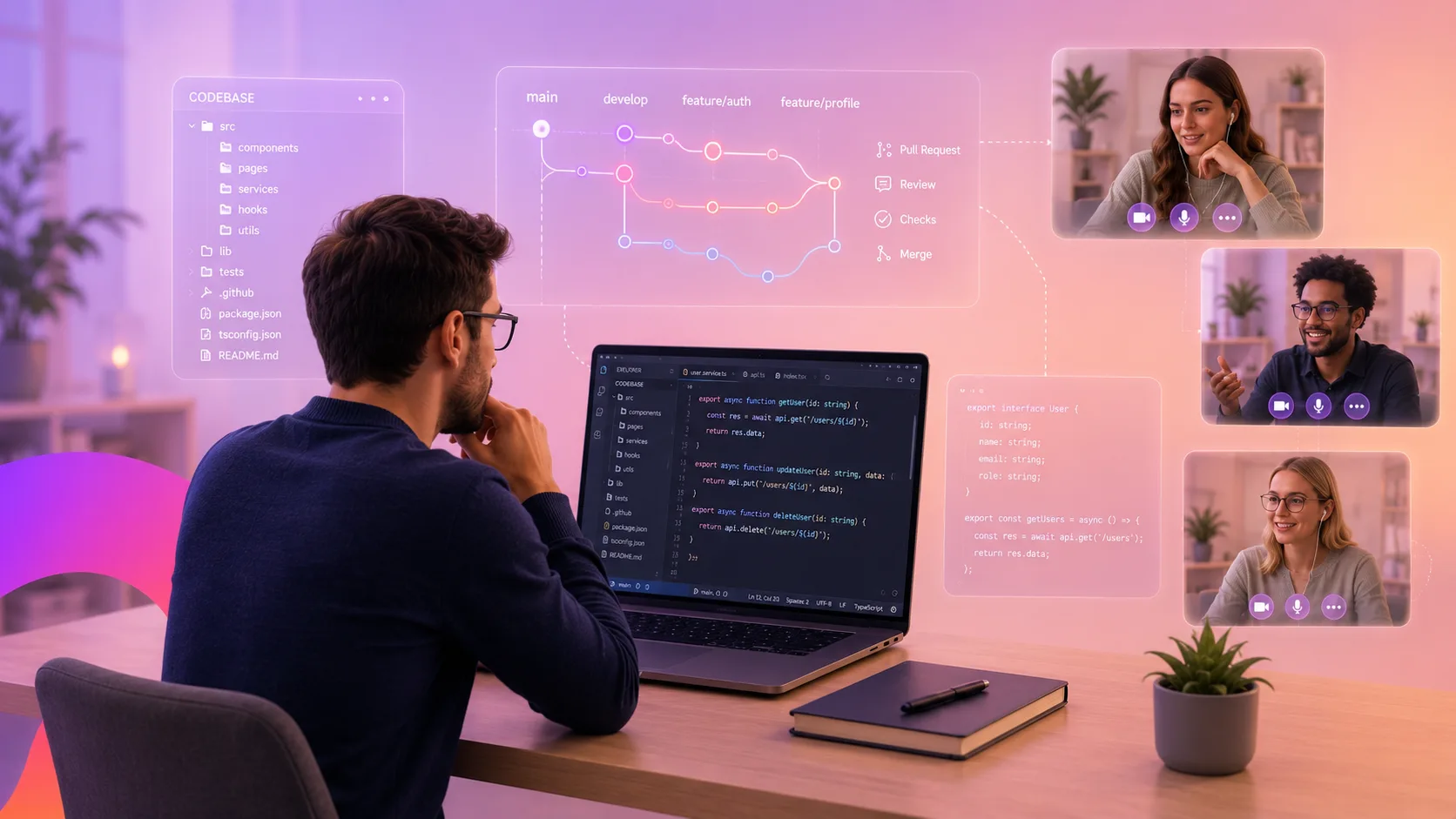
Within a collocated office environment, engineers resolve the ambiguity within low-friction exchanges such as tapping someone on the shoulder, writing on the whiteboard, or having a short discussion over coffee. Within a distributed, multi-timezone environment, those same ambiguities create operational bottlenecks. It might take an entire eight-hour day for an engineer to get an answer regarding their local setup or undocumented API contracts.
To scale engineering output across borders, technical leaders must shift from relying on Tribal Knowledge to building Systematic Knowledge. Preparing a codebase for distributed teams requires three foundational pillars: Explicit Ownership Boundaries, Self-Serve Documentation, and Uncompromising CI/CD Discipline.
Pillar 1: Explicit Ownership Boundaries
When everyone owns everything, nobody owns anything. In a remote setup, a lack of clear domain boundaries causes two opposing problems: developers either hesitate to touch unfamiliar code for fear of breaking it, or multiple developers make conflicting changes simultaneously.
Architecting for distributed teams requires reducing cognitive load and domain overlap through explicit boundaries:
- CODEOWNERS Files: Leverage CODEOWNERS files within your repository (GitHub, GitLab, Bitbucket) to map file paths and directories to specific engineers or teams. This ensures Pull Requests (PRs) are automatically routed to the right domain experts without requiring manual pings on Slack or Teams.
- Modular Architecture: Whether utilizing microservices, a modular monolith, or strict domain-driven directory separation, enforce clear bounded contexts. When domains are decoupled, distributed teams can build, test, and refactor their services independently without constant merge conflicts.
- Clear Service Interfaces & API Contracts: Establish well-defined internal APIs. By enforcing clear contracts (using tools like gRPC or GraphQL schemas), dependent teams in different time zones can develop against mock data without waiting for upstream services to be fully completed.
Pillar 2: “Self-Serve” Asynchronous Documentation
Documentation cannot be an afterthought in an asynchronous engineering environment; it is critical infrastructure. If a developer requires synchronous human help to on-board, develop, or deploy something, you have failed the distribution criteria.
For removing time zone delays, engineers must be able to serve themselves information directly from the code:
- Living READMEs & Automated Environments: Onboarding should take minutes, not days. Maintain single-command setup instructions (e.g., docker-compose up) or leverage automated cloud environments like Devcontainers or Gitpod. If environment setup breaks, fixing the setup script must be treated as a high-priority bug.
- Architecture Decision Records (ADRs): Code tells you what was built, but it rarely tells you why. Store lightweight, version-controlled markdown files directly in the repository to document major architectural decisions, trade-offs, and context. When an engineer in a different time zone asks why a specific database or pattern was chosen, the ADR provides immediate context.
- Inline & Self-Documenting API Specs: Use tools like OpenAPI/Swagger or TypeSpec to generate live, interactive documentation directly from the codebase. Keeping specs tightly bound to the code guarantees that documentation stays updated as APIs evolve.
Pillar 3: Uncompromising CI/CD Discipline
A broken main branch or a flaky test suite in a co-located office is an inconvenience; in a global team, it is a productivity bottleneck that stalls progress across entire regions. Asynchronous development demands strict, automated guardrails.
- Automated Guardrails: Move code quality enforcement out of human code reviews and into automated pipelines. Use pre-commit hooks, static analysis, and strict linters to handle formatting, style, and security checks before a human ever opens the PR.
- Small, Atomic Pull Requests: Enforce a culture of small, single-purpose PRs. Smaller reviews reduce cognitive load for reviewers operating in different time zones, lower the risk of complex merge conflicts, and significantly speed up approval cycles.
- Trunk-Based Development & Feature Flags: Decouple code deployment from feature releases. By merging small increments into the main branch behind feature flags, teams avoid long-lived feature branches that diverge over time, enabling continuous integration without risking production stability.
Technical Architecture Drives Engineering Velocity
Preparing a codebase for distributed teams isn’t extra administrative overhead; it is standard engineering excellence. The mechanisms that enable seamless asynchronous collaboration across time zones, clear domain boundaries, self-serve context, and automated testing are the exact same principles that make local, co-located teams operate faster and with fewer errors.
Ultimately, your global engineering organization will scale only as fast as the asynchronous technical workflows supporting it.
But even if you have your code ready for a distributed architecture, you still need software engineers that work well in an asynchronous manner.
At RapidBrains, our focus is on sourcing and evaluating senior remote talent in order to ensure that they have sufficient technical expertise and ability to create self-documenting systems and communicate asynchronously. Rather than taking several months to hire and onboard developers that find it hard to deal with timezone differences, RapidBrains will provide you with already vetted engineers.