Finding skilled software engineers locally has become one of the biggest bottlenecks for growing tech companies. Rising domestic salaries and intense competition for senior talent have forced engineering leaders to look beyond their local markets.
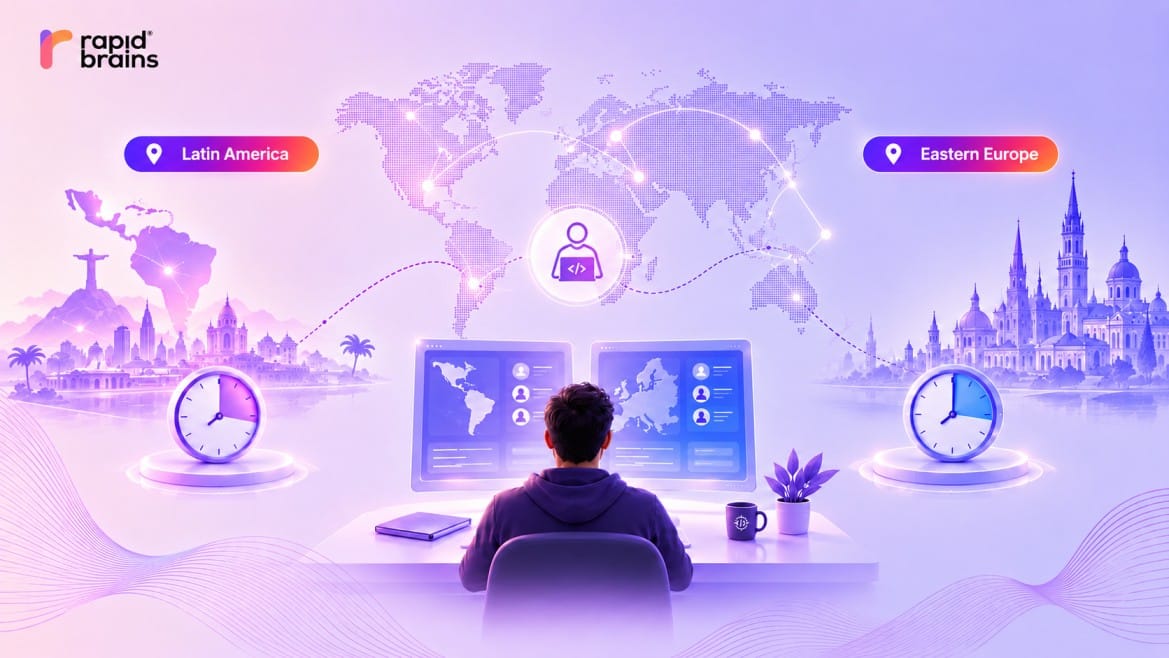
When expanding globally, two regions dominate the conversation: Latin America (LATAM) and Eastern Europe. Both offer world-class talent, but their operational environments differ significantly.
Hiring Developers in Latin America vs. Eastern Europe comes down to three key trade-offs: time zone alignment, cost efficiency, and specialized technical skill sets.
Timezone & Collaboration: Real-Time Sync vs. Asynchronous Power
Communication flow dictates project momentum. The structural differences in working hours across both regions shape how engineering teams collaborate daily.
Latin America: Nearshore Real-Time Alignment
For companies based in North America, LATAM offers near-perfect time zone overlap. Major tech hubs like Brazil (BRT), Colombia (COT), Mexico (CST), and Argentina (ART) operate within 0 to 3 hours of US Eastern Time, as shown on world time zone maps.
- Agile Integration: Engineering teams can implement standard Agile methodologies for real-time daily standups, instant Slack discussions, and pair-programming without scheduling friction.
- Faster Iteration: Unblocking a developer takes minutes rather than overnight wait times, which is why many companies scale rapidly using LATAM React Talent.
- Cultural Affinity: LatAm tech hubs share strong business culture overlaps with North American teams, simplifying communication.
Eastern Europe: The Overlap & Asynchronous Balance
Countries like Poland, Romania, Ukraine, and Bulgaria sit in Central and Eastern European time zones (CET/EET). For US-based companies, this results in a 6 to 10-hour time difference, though Western European businesses enjoy near-zero offset.
- 4-Hour US Window: US East Coast teams typically get a 3 to 4-hour daily overlap (usually late morning US time), sufficient for sync meetings and handoffs.
- Follow-the-Sun Productivity: Code submitted by US product managers at the end of their workday can be reviewed, tested, or built upon by Eastern European developers while the US team sleeps.
- Structured Autonomy: Eastern European engineers excel in asynchronous environments, working independently against clear documentation.
Cost Trade-offs: Rates, Taxes, and Retainers
Offshore software development allows companies to optimize engineering budgets without sacrificing quality when they choose to hire dedicated developers. However, senior talent in both regions commands competitive compensation.
| Role Level | LATAM | Eastern Europe |
| Mid-Level Developer | $35 – $55 / hr | $40 – $60 / hr |
| Senior Developer | $55 – $80 / hr | $60 – $90 / hr |
| Tech Lead / Architect | $75 – $110 / hr | $80 – $120+ / hr |
LATAM Pricing Dynamics
- Rate Trends: Rates in Latin America have risen due to high demand from US tech firms.
- Cost Drivers: Nearshore convenience carries a small premium, particularly for senior React, Node.js, and Python developers.
- Net Savings: Companies still cut talent costs by 50% to 60% compared to equivalent US-based hires.
Eastern Europe Pricing Dynamics
- Rate Trends: Eastern Europe offers slightly broader price variation based on specific country dynamics.
- Cost Drivers: Rates in EU-member countries (like Poland and Romania) reflect higher local taxes and living costs compared to non-EU tech hubs.
- Value Proposition: Higher rates in Eastern Europe often correlate with deep architectural specialization, math-heavy engineering backgrounds, and complex technical problem-solving capabilities.
Skill Sets & Academic Foundation: Where Each Region Excels
Both regions produce high-caliber software talent, but their educational systems and tech ecosystems foster distinct strengths.
- Latin America Strengths: Full-Stack Web, Mobile Development, Cloud Operations, and Agile Product Engineering.
- Eastern Europe Strengths: Deep Tech / AI / ML, Systems Engineering, Complex Algorithms, Security, and Fintech.
LATAM Skills & Ecosystem
Latin America’s talent growth has been driven by rapid digital transformation, e-commerce expansion, and venture capital investment across the Americas.
- Core Strengths: Demand is particularly high for skilled front-end developers specializing in React and Node.js, as well as experienced mobile developers proficient in Flutter, React Native, and Swift.
- Product Mindset: LatAm developers often work closely with fast-moving startups, giving them strong product intuition and adaptability to changing product roadmaps.
- Language Proficiency: English proficiency among tech workers in Latin America has surged, driven by nearshore demand.
Eastern Europe Skills & Ecosystem
Eastern Europe has a long-standing legacy of rigorous STEM education, producing engineers with deep scientific and mathematical foundations.
- Core Strengths: Complex backend architecture, Artificial Intelligence / Machine Learning, C++, Rust, Embedded Systems, Cybersecurity, and Fintech algorithms.
- Competitive Coding & STEM: Countries like Poland, Ukraine, and Romania consistently rank near the top on developer assessment platforms.
- Enterprise Scale: Developers here frequently have experience building complex, enterprise-grade software architectures for global Fortune 500 companies.
Comparison Matrix: LATAM vs. Eastern Europe
| Feature | Latin America (LATAM) | Eastern Europe |
| Primary Time Zone | UTC-3 to UTC-6 (EST / CST / PST friendly) | UTC+1 to UTC+3 (CET / EET friendly) |
| US Time Overlap | 6 to 8 hours (Full day) | 2 to 4 hours (Half day) |
| EU Time Overlap | 2 to 4 hours | 6 to 8 hours (Full day) |
| Key Tech Hubs | Brazil, Mexico, Colombia, Argentina | Poland, Romania, Ukraine, Bulgaria |
| Engineering Focus | Web, Mobile, Cloud, SaaS Products | Deep Tech, AI/ML, Security, Systems |
| Work Style Preference | Highly collaborative, Real-time sync | Asynchronous, Autonomous, Documentation-led |
| Average Cost Savings | 50% – 65% vs. US domestic | 45% – 60% vs. US domestic |
The Verdict: How to Choose for Your Tech Stack
Choosing between Latin America and Eastern Europe depends on your team’s workflows, existing time zones, and technical requirements.
Choose Latin America if:
- You are a North American team that requires real-time daily collaboration and constant Slack/Zoom communication.
- You are building modern SaaS, mobile apps, or web platforms using standard cloud-native stacks.
- You follow fast-paced Agile methodology with changing daily priorities that benefit from shared working hours.
Choose Eastern Europe if:
- You are building complex algorithms, AI/ML models, deep-tech platforms, or enterprise-grade backend infrastructure.
- Your engineering management is comfortable operating in an asynchronous environment with clear documentation and ticket handoffs.
- You are based in Western Europe or the UK and want nearshore time zone alignment.
Simplify Global Hiring with RapidBrains
Navigating international payroll, local labor laws, background checks, and technical screening across LATAM or Eastern Europe can overwhelm internal hiring teams.
RapidBrains simplifies global tech recruitment. With a talent network of over 500,000 pre-screened developers, RapidBrains helps you source, vet, and onboard top remote engineers in LATAM, Eastern Europe, and beyond in as little as 24 hours. We also guide teams through a structured 30-day onboarding plan to guarantee high long-term retention. RapidBrains handles international compliance, contract management, and payroll so you can focus entirely on building your product.