For decades, engineering hiring followed a predictable rule: build teams where the company had offices.
A business headquartered in London hired primarily in the UK. A startup in San Francisco competed for engineers in the Bay Area. A European scale-up looking to expand its development team typically opened another local office or established an offshore development center.
That model is steadily losing relevance.
Today, an engineering team might have a backend developer in Poland, an AI engineer in India, a DevOps specialist in Portugal, and a product engineering lead in the UK, all contributing to the same product.
This is not simply a response to the remote-work boom. It reflects a more fundamental shift in how companies access technical skills, structure engineering organizations, and scale product development.
The data increasingly points in one direction: the future engineering workforce is becoming borderless.
Remote Engineering Is No Longer an Exception
Remote work has become firmly embedded in software development.
The 2025 Stack Overflow Developer Survey, which collected more than 49,000 responses across 177 countries, found that nearly one-third of developers work remotely. In the United States, that figure reaches 45%.
The previous year’s data tells an equally important story. In the 2024 survey, 42% of developers reported working in hybrid environments.
The takeaway is not that every engineering organization will become fully remote.
It is that location is becoming less important as a prerequisite for collaboration.
Engineering organizations have spent the last several years building the infrastructure required to operate distributed teams: cloud development environments, asynchronous communication, collaborative code repositories, project management platforms, automated CI/CD pipelines, observability tools, and increasingly, AI-assisted development environments.
Once that infrastructure exists, the question for a CTO changes.
Instead of asking:
“Who can we hire within commuting distance of our office?”
The question becomes:
“Where can we find the best engineer for this problem?”
That is a much larger talent market.
The Developer Talent Market Is Already Global
Software development has never been concentrated in a single country, but distributed work makes that global talent base significantly more accessible to employers.
Stack Overflow’s 2025 survey illustrates just how geographically distributed the developer ecosystem has become. Respondents came from 177 countries, with substantial developer communities represented across the United States, Germany, India, the UK, France, Canada, Ukraine, Poland, the Netherlands, Brazil, Spain, Sweden, Switzerland, Romania, and many others.
For engineering leaders, this changes the economics of hiring.
A company searching for a highly specialized engineer no longer needs to limit its recruitment funnel to a single metropolitan area.
The available market can potentially extend across multiple countries and time zones.
This becomes particularly important when hiring for specialized capabilities such as:
• AI and Machine Learning
• MLOps
• Cloud Infrastructure
• DevOps and DevSecOps
• Data Engineering
• Cybersecurity
• Platform Engineering
• Backend Engineering
• AI Infrastructure
• Forward Deployed Engineering
The more specialized the requirement becomes, the less practical a location-restricted hiring strategy can be.
Borderless Hiring Changes the Talent Equation
Traditional hiring usually forces companies to optimize around three constraints:
Skill, Location, and Availability.
Finding all three simultaneously can create lengthy recruitment cycles.
Removing location as a hard constraint fundamentally expands the available talent pool.
Consider a company looking for an engineer with experience across Kubernetes, AWS, Terraform, Python, and distributed systems.
Under a local-first model, recruiters search for candidates with that combination within a specific city or region.
Under a borderless model, the search can extend across multiple established and emerging technology hubs.
The requirement remains the same.
The address does not.
That difference matters when engineering roadmaps are moving faster than recruitment pipelines.
Developers Value the Conditions That Remote-First Teams Can Enable
The shift is not being driven exclusively by employers looking for larger talent pools.
Developer expectations matter too.
According to Stack Overflow’s 2025 survey, autonomy and trust to manage one’s own tasks ranked as the most important contributor to developer job satisfaction, ahead of competitive compensation and solving real-world problems.
That is particularly relevant to distributed engineering.
Successful remote-first organizations tend to operate around outcomes rather than physical presence. Engineers need clear ownership, measurable objectives, strong documentation, and enough autonomy to make decisions without constantly waiting for synchronous approval.
Remote work therefore works best when it is not treated as simply “office work conducted over video calls.”
It requires a different operating model.
Productivity Is Only Part of the Story
The debate around remote engineering often gets reduced to one question:
“Are remote developers more productive?”
That question misses the larger opportunity.
GitLab’s research into remote work found that 81% of respondents were satisfied with their productivity levels while working remotely. Respondents also identified increased productivity, increased efficiency, reduced bureaucracy, and improved documentation and processes among the benefits employers experienced from remote environments.
But distributed work also introduces challenges.
In the same research, only 37% of respondents felt their organizations did a good job of aligning work across projects.
That distinction is important.
Remote work does not automatically create a high-performing engineering organization.
Remote infrastructure enables distributed work. Operating discipline makes distributed work successful.
The strongest borderless teams build around:
• Clear ownership and accountability
• Documentation-first workflows
• Defined communication protocols
• Strong engineering standards
• Asynchronous decision-making
• Intentional time-zone overlap
• Transparent project visibility
• Outcome-based performance measurement
Without these practices, geographic distribution can create fragmentation.
With them, geography becomes far less relevant.
AI Is Making Distributed Engineering Even More Practical
There is another force accelerating the shift: AI-assisted software development.
The 2025 Stack Overflow Developer Survey found that 69% of AI-agent users said agents increased their productivity, while approximately 70% said they reduced the time required for specific development tasks.
AI development tools can help engineers generate boilerplate code, understand unfamiliar codebases, write tests, debug problems, document systems, and accelerate repetitive development tasks.
However, the same survey found that only 17% of AI-agent users believed agents improved team collaboration.
That creates an interesting distinction for engineering leaders.
AI can make individual developers faster.
It does not automatically make distributed teams better.
The competitive advantage therefore comes from combining AI-enabled productivity with strong remote engineering practices.
The New Engineering Hub May Not Be a Place
Historically, scaling engineering meant opening offices.
Companies established engineering centers in cities with strong universities, existing technology ecosystems, favorable labor economics, and sufficient technical talent.
Those hubs will continue to matter.
But the concept of an engineering hub itself is changing.
A modern engineering organization can create a virtual talent hub spanning multiple markets instead of concentrating every specialist in one physical location.
A European SaaS company, for example, could maintain product leadership close to its headquarters while adding cloud engineers, AI specialists, backend developers, QA engineers, and DevOps professionals from other regions.
The organization gains access to a broader skills base without needing to establish a physical operation every time it enters a new talent market.
That gives engineering leaders another way to think about scale:
Build capabilities, not necessarily offices.
From Remote Hiring to Global Talent Orchestration
There is an important difference between hiring a few remote developers and building a genuinely borderless engineering organization.
The first is a recruitment decision.
The second is an operating strategy.
As teams become increasingly distributed, organizations need systems for managing:
contracts, payroll, local employment requirements, onboarding, security, intellectual property, equipment, performance, communication, and cross-border compliance.
This is where the remote-work conversation is evolving.
The challenge is no longer simply whether engineers can work remotely.
We already know they can.
The next challenge is determining how organizations can identify, onboard, integrate, and manage specialized global engineering talent efficiently at scale.
What This Means for Engineering Leaders
For CTOs and engineering leaders, borderless hiring creates a significant opportunity, but it also requires a shift in mindset.
Hiring strategy can no longer be designed independently from engineering strategy.
If the roadmap requires an AI infrastructure engineer today, a cybersecurity specialist next quarter, and additional backend capacity for six months, the talent model needs to accommodate that variability.
The companies positioned to scale fastest will increasingly be those capable of accessing expertise wherever it exists rather than waiting for the right candidate to appear within a predefined geographic radius.
This does not mean every engineering role should be remote.
It means location should become a strategic variable rather than a default restriction.
Building the Borderless Engineering Team
At RapidBrains, we see this shift reflected in how companies approach technical hiring.
Organizations are increasingly looking beyond conventional recruitment models toward flexible global talent networks that allow them to add specialized engineering capabilities when their roadmaps demand them.
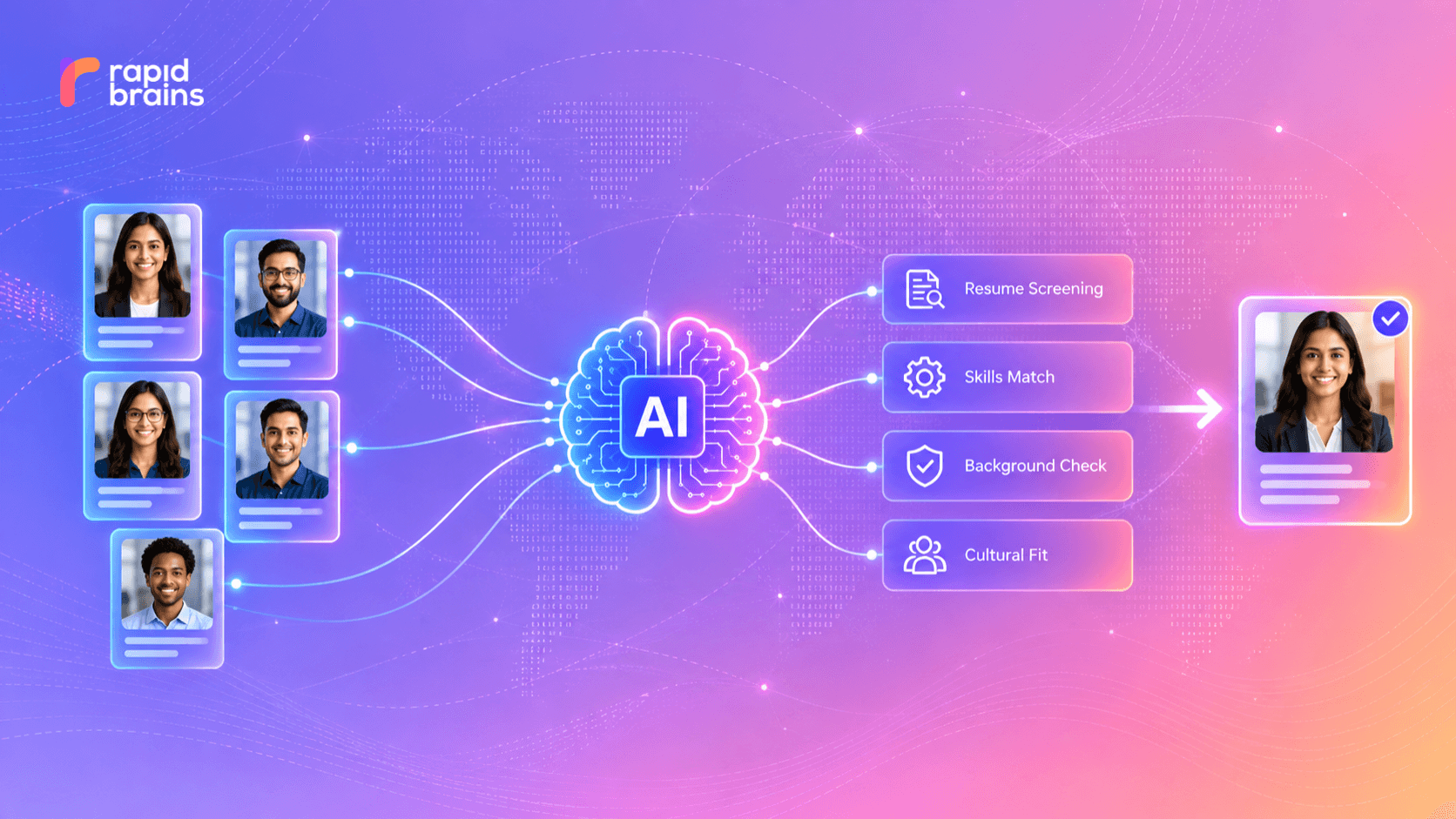
RapidBrains connects companies with a global network of 500,000+ pre-vetted professionals across 40+ countries, covering capabilities from software engineering and cloud infrastructure to AI/ML, DevOps, cybersecurity, data, and emerging engineering roles.
Talent can be engaged full-time, part-time, or on contract, with onboarding possible within 24 hours and zero hiring fees.
The objective is not simply to make engineering teams remote.
It is to make access to engineering talent less dependent on geography.
Because the next great engineer for your team may not live in your city.
They may not even live in your country.
And increasingly, that does not need to matter.
The Bottom Line
The office is no longer the boundary of the engineering organization.
Developer communities are global. Remote and hybrid work are established parts of the technology workforce. AI is increasing individual engineering productivity. Collaboration infrastructure has matured. And companies can access specialized capabilities across borders more easily than ever before.
The next phase of engineering growth will therefore be less about deciding between “office” and “remote.”
It will be about designing teams around skills, outcomes, collaboration, and speed, regardless of where those skills happen to be located.
The future engineering organization is not defined by an address.
It is defined by access to the right talent.