
The in-demand freelance skills that paid well five years ago and the ones commanding top rates today are not the same list. AI-enabled skills on Upwork’s marketplace grew 109% year-over-year overall, with AI integration up 178% and AI video generation up 329%. Python hit 57.9% usage among developers in the Stack Overflow 2025 Developer Survey, up 7 percentage points in a single year. That isn’t gradual drift. That is a market repricing skills in real time.
This guide ranks the 20 most in-demand freelance skills by hourly rate, growth momentum, and how hard they are to hire. Whether you are staffing a technical team or deciding what to learn next, the rankings are grounded in actual earnings data, not speculation.
Sources: Upwork 2026 In-Demand Skills Report (Jan–Dec 2025 earnings data, US origin) | Stack Overflow Developer Survey 2025 (released December 2025, 49,000+ respondents, 177 countries) | RapidBrains hiring data, 2025
How these rankings work
Three sources went into this: Upwork’s 2026 In-Demand Skills report (based on completed jobs from January–December 2025 generating at least $100K in freelancer earnings), the Stack Overflow Developer Survey 2025 (released December 2025), and internal hiring data from RapidBrains clients in the US, UK, and EU.
The hourly ranges shown are open-market freelance rates: what a company typically pays on Upwork, Toptal, or similar platforms. If you hire through full-time remote staffing, the effective monthly cost runs 40–60% lower for equivalent skill levels. More on that at the end.
All 20 in-demand freelance skills at a glance
| # | Skill | Avg Rate (USD/hr) | YoY Growth | Difficulty to Hire |
| 1 | Generative AI / LLM development | $80–$150/hr | AI-enabled: +109% | Very hard |
| 2 | Machine learning engineering | $70–$130/hr | +65% YoY | Very hard |
| 3 | Cybersecurity | $60–$120/hr | +45% YoY | Very hard |
| 4 | Blockchain / Web3 development | $65–$115/hr | +18% YoY | Very hard |
| 5 | Cloud engineering | $60–$110/hr | +38% YoY | Hard |
| 6 | DevOps / platform engineering | $55–$105/hr | +32% YoY | Hard |
| 7 | Data engineering | $55–$100/hr | +28% YoY | Hard |
| 8 | Python development | $50–$100/hr | +25% YoY | Hard |
| 9 | Full-stack development | $50–$95/hr | +22% YoY | Moderate |
| 10 | Mobile app development | $50–$90/hr | +15% YoY | Moderate |
| 11 | React / front-end development | $45–$85/hr | +20% YoY | Moderate |
| 12 | Prompt engineering | $40–$70/hr | +180% YoY | Easy-moderate |
| 13 | Data analytics / BI | $40–$75/hr | +22% YoY | Moderate |
| 14 | UI/UX design | $40–$80/hr | +18% YoY | Moderate |
| 15 | No-code / automation (Zapier, Make) | $35–$70/hr | +74% YoY | Easy |
| 16 | Video production and editing | $30–$65/hr | +25% YoY | Easy |
| 17 | SEO / content strategy | $25–$65/hr | +15% YoY | Easy |
| 18 | Copywriting | $25–$60/hr | +12% YoY | Easy |
| 19 | Social media marketing | $20–$55/hr | +36% YoY | Easy |
| 20 | Virtual assistance | $15–$35/hr | +10% YoY | Very easy |
The chart below shows the same 20 skills visualized by maximum hourly rate, with bar color indicating how difficult each skill is to hire for.
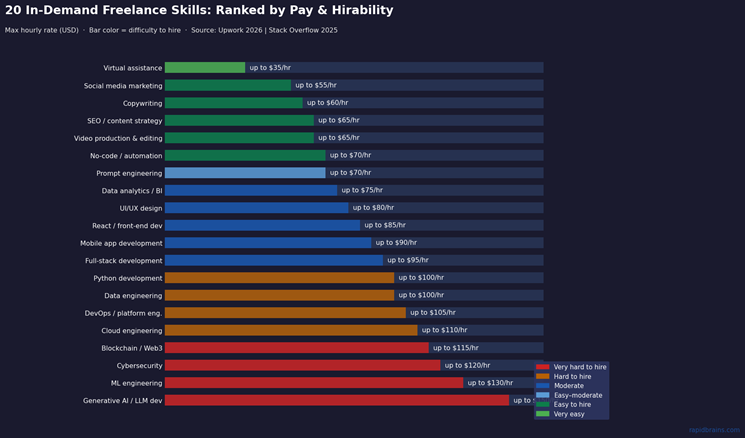
Figure 1: All 20 in-demand freelance skills ranked by max hourly rate, color-coded by hiring difficulty.
Highest paying freelance skills (ranks 1–8)
These are the skills where demand consistently outstrips supply. Hiring for any of them on an open marketplace involves weeks of screening, and you are competing with offers from well-funded companies. The rates reflect that scarcity.
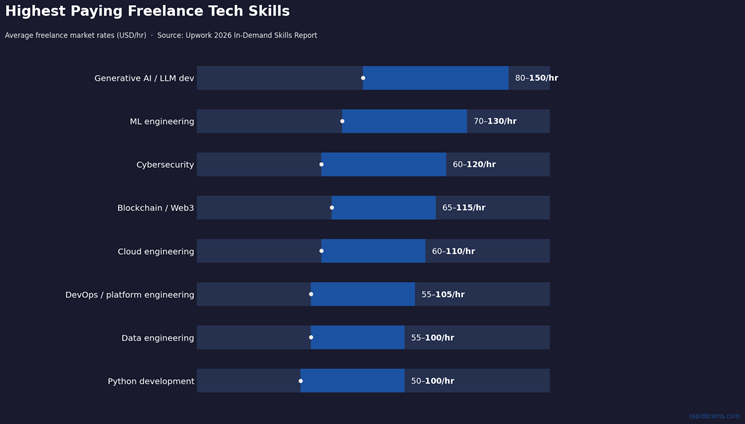
Figure 2: Highest paying freelance tech skills — average market rate ranges. Source: Upwork 2026 In-Demand Skills Report.
1. Generative AI and LLM development — $80–$150/hr
AI-enabled skills in coding grew 109% overall on Upwork in 2026, with AI integration up 178% and AI chatbot development up 71% year-over-year. LLM and generative AI development sit at the top of this category, driven by companies building RAG pipelines, fine-tuning open-source models, and integrating tools like LangChain or LlamaIndex into production. The scarcity problem is real: most practitioners have fewer than three years of hands-on experience because the tooling did not exist before that.
Hire AI developers: rapidbrains.com/ai-developers
2. Machine learning engineering — $70–$130/hr
Distinct from data science: ML engineers build the infrastructure that gets models into production — pipelines, model serving, monitoring, retraining. Python is the lingua franca, with PyTorch and TensorFlow as standard frameworks. The Stack Overflow 2025 survey found Python adoption jumped sharply this year, partly driven by AI and ML use cases.
Hire machine learning engineers: rapidbrains.com/machine-learning-engineers
3. Cybersecurity — $60–$120/hr
Penetration testing, cloud security architecture, SOC analysis, and compliance work (SOC2, ISO 27001, HIPAA) all fall here. The talent gap has widened consistently over three years. Many companies don’t need a full-time hire. They need an experienced specialist for 20–30 hours a week, which makes remote staffing a natural fit.
4. Blockchain and Web3 development — $65–$115/hr
Solidity developers and smart contract auditors are expensive and hard to find. The sector cooled in 2022–2023 but recovered steadily through 2024, particularly in financial services and supply chain. This isn’t a beginner-friendly skill. It rewards people who already understand distributed systems and cryptographic primitives.
5. Cloud engineering — $60–$110/hr
AWS, GCP, and Azure certifications are table stakes. What companies pay for is someone who can architect cost-efficient, secure infrastructure, not just navigate a console. Cloud engineers who do infrastructure-as-code (Terraform, Pulumi) sit at the higher end of the range.
Hire cloud engineers: rapidbrains.com/cloud-engineers
6. DevOps and platform engineering — $55–$105/hr
The line between DevOps, SRE, and platform engineering has blurred, but what has not changed: companies with complex CI/CD pipelines and Kubernetes clusters need people who own reliability. Kubernetes, Docker, GitHub Actions, and observability tooling (Datadog, Grafana) are standard requirements for mid-to-senior roles.
Hire DevOps engineers: rapidbrains.com/devops-engineers
7. Data engineering — $55–$100/hr
Data engineers build and maintain the pipelines that feed analytics, ML models, and BI tools. dbt, Apache Spark, Airflow, and Snowflake appear in most job postings. Demand is up partly because companies are cleaning up their data infrastructure ahead of AI projects. Poor data quality is the most common reason model deployments fail.
8. Python development — $50–$100/hr
Python is now used by 57.9% of developers surveyed by Stack Overflow — up 7 percentage points in a single year. It’s the first choice for backend, automation, AI tooling, and data work. A generalist Python developer with production experience in FastAPI or Django can slot into almost any production stack.
Hire Python developers: rapidbrains.com/python-developers
Hiring any of these skills? RapidBrains places full-time remote developers from $12/hr. No agency fee, no per-hire markup, EOR-managed compliance included.
Best freelance skills to learn (ranks 9–15)
These skills have strong hiring demand and are more accessible than the top tier — meaning it is realistic to reach a hireable level within 12–18 months of focused work. Companies actively look for these on both project platforms and for full-time remote roles.
9. Full-stack development — $50–$95/hr
Full-stack development held the number one spot in Upwork’s coding category for both the 2025 and 2026 In-Demand Skills reports. Node.js or Python backends paired with React frontends is the most common stack. The pay ceiling is lower than ML or AI, but the volume of available work is higher by a wide margin. For anyone building a career, that matters.
Hire full-stack developers: rapidbrains.com/full-stack-developers
10. Mobile app development — $50–$90/hr
Flutter and React Native have narrowed the divide between iOS and Android development. Cross-platform developers who ship on both are in steady demand, particularly in e-commerce and health tech. Swift and Kotlin remain valuable for companies that need native-quality performance on a specific platform.
11. React and front-end development — $45–$85/hr
React has been the dominant front-end framework for several consecutive years. TypeScript fluency is now expected for mid-to-senior front-end roles. Web design ranked second in Upwork’s coding category in the 2026 In-Demand Skills report. Companies rebuilding for performance and conversion are driving that.
Hire React developers: rapidbrains.com/react-js-developers
12. Prompt engineering — $40–$70/hr
Contentious. Basic prompt writing will be automated. But complex agentic workflows — multi-step reasoning, tool-calling, evaluation pipelines — still require someone who understands how LLMs behave under different conditions. Treat this as a complementary skill rather than a standalone career path.
13. Data analytics and BI — $40–$75/hr
SQL, Python (pandas), and visualization tools — Tableau, Power BI, Looker — are the core stack. Companies with maturing data infrastructure need someone to translate numbers into decisions, not just dashboards. This skill has the advantage of being legible to non-technical stakeholders, which makes analysts easier to justify to leadership.
14. UI/UX design — $40–$80/hr
Figma has consolidated the design tool market. UX researchers and product designers who combine interaction design with user research command the higher end of this range. Demand spiked as companies recognized that poor UX has a measurable revenue cost — not just an aesthetic one.
15. No-code and automation — $35–$70/hr
Zapier, Make (formerly Integromat), Airtable, and similar tools have created a real market for specialists who can build workflows that non-engineers can maintain. Demand grew 74% year-over-year on Upwork — partly because companies adopting AI tools also need someone to build the automations that connect them.
Freelance skills for beginners (ranks 16–20)
Lower hourly rates, but genuine entry points that do not require a computer science degree or years of practice. If you are starting from scratch and need income within six months, these are realistic.
A note for hiring companies: easy to find does not mean quality does not matter. The output difference between a mediocre social media manager and a good one shows up in your metrics. Low barrier to entry means more noise in the applicant pool — not a lower bar for what you should accept.
16. Video production and editing — $30–$65/hr
Short-form video has moved from optional to expected for most marketing teams. Editors who understand pacing for YouTube, LinkedIn, and short-form formats are in steady demand. Adobe Premiere and DaVinci Resolve are standard tools; editors who can also handle color grading and basic motion graphics sit at the higher end of the range.
17. SEO and content strategy — $25–$65/hr
Search is evolving with AI-generated results, but organic traffic still matters for most businesses. Content strategists who understand keyword intent, internal linking, and how to structure articles for both readers and crawlers have a skill set that holds up even as the surface-level execution tools change.
18. Copywriting — $25–$60/hr
Good copywriters are harder to find than the rate suggests. Writing that converts — email subject lines, landing pages, product descriptions — requires understanding the audience, not just producing text. AI has raised the floor for average copy and compressed rates for generalists, but specialists in specific industries or high-stakes formats still command solid rates.
19. Social media marketing — $20–$55/hr
Social media strategy grew 36% year-over-year on Upwork’s platform in 2026. Platform-specific expertise matters more than general social media knowledge — LinkedIn B2B, Instagram e-commerce, and short-form content creation are distinct skill sets that routinely get lumped into one job description.
20. Virtual assistance — $15–$35/hr
The range is wide because the role covers everything from calendar management to executive-level research. Executive virtual assistants with domain-specific knowledge sit at the top. General data entry and scheduling work sits at the bottom. Upwork listed general virtual assistance as the single most-hired skill in customer service and admin support — confirmed by both the 2025 and 2026 In-Demand Skills reports.
What companies are actually hiring for right now
The Upwork 2026 report has a counterintuitive finding: AI-enabled skills grew 109% overall, yet the most-hired skills in coding, design, marketing, and customer support remained consistently strong, including in categories often assumed to be most vulnerable to automation. 77% of business leaders say AI is increasing their need for specialized, fractional talent rather than traditional full-time roles. Companies are using AI to identify more precisely where human expertise matters. That’s different from replacing people.
The Stack Overflow Developer Survey 2025 (released December 2025) adds context: 84% of developers use AI tools in their workflow, but more developers actively distrust AI output (46%) than trust it (33%). That’s not a small gap. The role of human expertise in validating and directing AI work isn’t shrinking. It’s the bottleneck.
Sources: Upwork 2026 In-Demand Skills Report | Stack Overflow Developer Survey 2025
How to hire these skills without overpaying
The rates in this guide are open-market freelance rates: what you typically pay on Upwork or Toptal. Platform fees, project overhead, and the premium for on-demand availability all factor into those numbers.
The alternative is full-time remote staffing. A senior Python developer, cloud engineer, or React specialist working full-time through RapidBrains starts from $12/hr — all-in. No hiring fee, no markup, no surprise invoices. RapidBrains handles employment, compliance, and onboarding through an Employer of Record model, so the hire integrates with your team exactly like a direct employee.
The practical difference: a developer you would pay $80–$100/hr for on Upwork (project basis, no continuity guarantee) costs a fraction of that as a full-time remote hire. For anything beyond a single project, the economics favor staffing.
See what remote hiring actually costs: How much does it cost to hire a software developer?
RapidBrains developers start from $12/hr. No agency fee. No per-hire markup. Hire Python, React, full-stack, ML, cloud, DevOps, and AI developers — fully vetted and ready to start within 24–48 hours.
The takeaway
The freelance skills market is splitting into two very different tiers. At the top (AI, ML, cybersecurity, cloud), rates are high, talent is scarce, and companies compete hard for the same people. At the accessible end, AI has automated enough routine work that generalist roles pay less and attract more candidates.
The middle is where most hiring decisions land: full-stack developers, data engineers, React specialists, DevOps engineers. These skills require enough depth that good practitioners are genuinely hard to find, but the market is large enough that consistent sourcing is achievable — particularly through remote staffing.
See available developers starting from $12/hr: rapidbrains.com/full-stack-developers