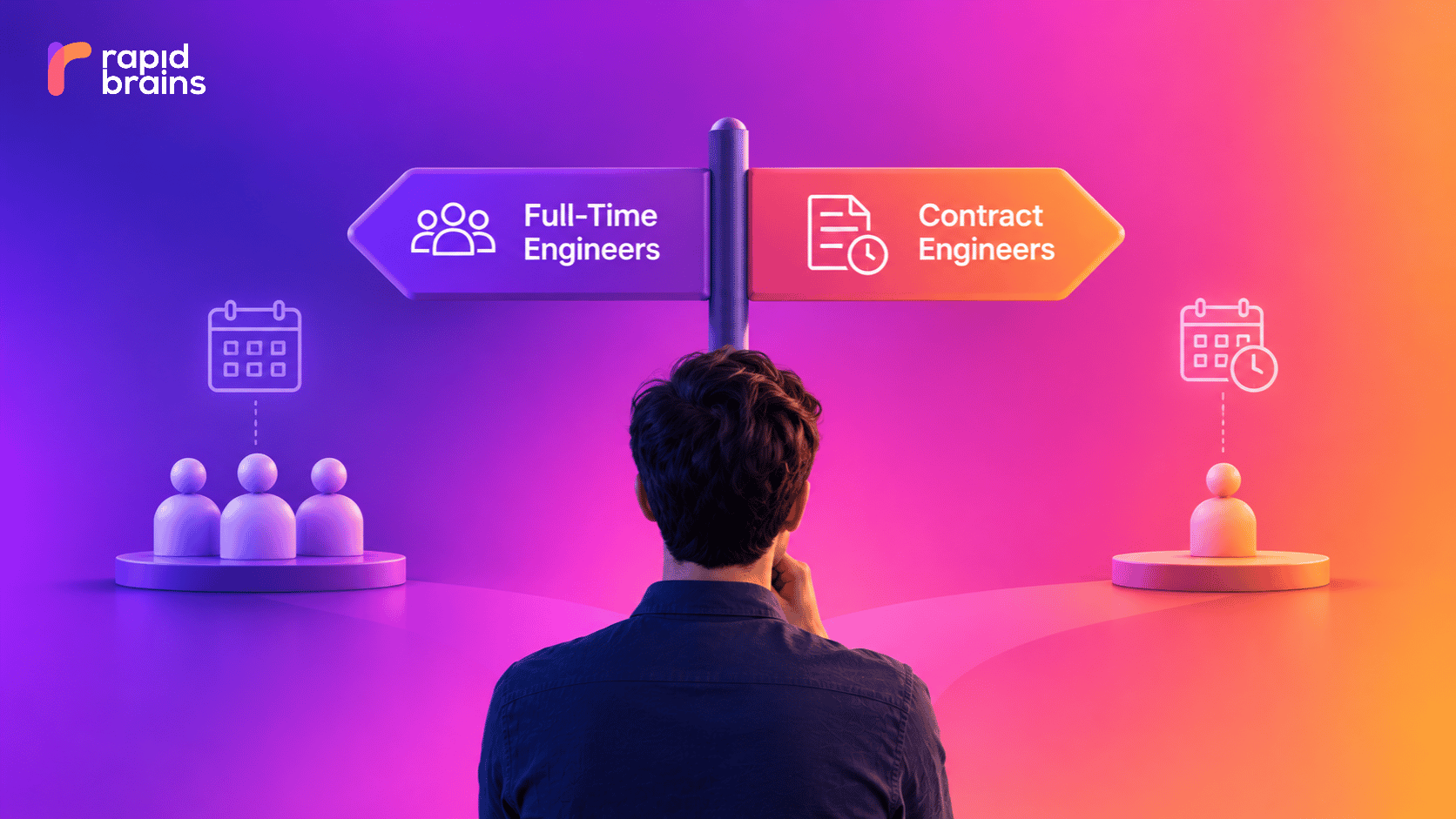
Building a strong engineering team requires more than finding people with the right technical skills. Businesses must also decide how to engage that talent, whether through permanent, full-time employees or contract engineers who join for a defined period or project.
The decision affects hiring costs, project timelines, team continuity, and the ability to respond to changing business needs. While full-time engineers can provide long-term ownership and institutional knowledge, contract engineers offer flexibility and access to specialized expertise without the same long-term employment commitment.
Neither model is universally better. The right choice depends on your development roadmap, existing team capabilities, project requirements, and future business priorities.
Understanding when to hire full-time versus contract engineers can help you build a team that meets immediate delivery goals while supporting sustainable growth.
What Is the Difference Between Full-Time and Contract Engineers?
Full-time engineers are permanent employees who work as part of your organization. They typically contribute to ongoing product development, maintain existing systems, collaborate across departments, and develop a deeper understanding of your business.
Contract engineers are engaged for a specific project, a defined period, or a particular business requirement. They may work independently or integrate directly into an existing engineering team. Their engagement can end when the project is completed or the need for their expertise changes, subject to the terms of the contract.
The primary difference is not technical capability. Both groups can bring considerable experience and deliver high-quality work. The distinction lies in the duration of engagement, cost structure, availability, and the level of long-term ownership expected from the role.
When Should You Hire Full-Time Engineers?
Full-time hiring makes sense when engineering is a continuous business function rather than a temporary requirement.
1. You Need Long-Term Product Ownership
Products that require continuous development benefit from engineers who understand their architecture, technical decisions, dependencies, and business objectives.
Full-time engineers accumulate this knowledge over time. They can identify recurring issues, make informed architectural decisions, and maintain consistency across development cycles.
For businesses building proprietary software, SaaS platforms, or technology products, this continuity can be particularly valuable.
2. Your Engineering Roadmap Is Predictable
If your product roadmap includes a consistent pipeline of development, maintenance, testing, and infrastructure work, a permanent engineering team can provide stability.
Rather than repeatedly sourcing talent for individual projects, businesses can establish a core team with clearly defined responsibilities and established workflows.
This approach is particularly useful when engineering capacity is a recurring requirement and the organization can sustain the associated employment costs.
3. You Need Deep Business and Domain Knowledge
Some engineering roles require an understanding of industry regulations, internal processes, customer behavior, or complex business logic.
Over time, full-time employees develop familiarity with these factors, reducing the need to repeatedly explain requirements and technical context.
This can be important in industries such as financial services, healthcare, enterprise software, and other environments where technical decisions have significant operational implications.
4. Collaboration and Continuity Are Critical
Full-time engineers can provide continuity across product, design, security, infrastructure, and business teams.
When development involves frequent discussions, evolving requirements, and long-term architectural decisions, having permanent team members can simplify collaboration.
However, this advantage depends on effective team management and documentation. Permanent employment alone does not guarantee alignment or knowledge retention.
When Should You Hire Contract Engineers?
Contract engineers are often the better choice when your requirements are specialized, time-sensitive, or likely to change.
1. You Have a Defined Project or Deadline
Launching a new application, migrating infrastructure, integrating an API, or developing a proof of concept may require additional engineering capacity for a limited period.
Hiring permanent employees for a short-term requirement can introduce unnecessary long-term commitments.
Contract engineers allow businesses to bring in the skills required for the project, work toward defined deliverables, and adjust team capacity when the engagement ends.
2. You Need Specialized Technical Expertise
Your existing team may be capable of maintaining and developing your product but lack experience in a particular technology.
For example, you might need engineers specializing in artificial intelligence, machine learning, cloud architecture, DevSecOps, data engineering, or cybersecurity.
Recruiting a permanent specialist may not be practical if the requirement is limited to a specific implementation or transformation initiative.
Contract hiring provides a way to access these skills when they are needed without necessarily creating a permanent position.
3. Your Workload Changes Frequently
Businesses experiencing seasonal demand, rapid expansion, or fluctuating project pipelines may struggle to maintain the right engineering capacity throughout the year.
Contract engineers offer greater flexibility when workloads increase temporarily.
An organization can expand its development team for a product launch, accelerate a migration, or support a new client engagement without committing to the same team size indefinitely.
4. You Need to Accelerate Delivery
Traditional recruitment can take time, particularly when positions require niche technical skills or experienced engineers.
When an existing team is working against a demanding deadline, contract engineers can provide additional capacity while permanent recruitment continues.
The effectiveness of this approach depends on how quickly suitable engineers can be identified, onboarded, and integrated into the project.
Clear documentation, defined responsibilities, and established development practices help contract engineers contribute more quickly.
Full-Time vs. Contract Engineers: What Should You Compare?
Before choosing an engagement model, evaluate the following factors.
Cost structure: Full-time employees involve salaries, benefits, recruitment expenses, equipment, and other employment-related costs. Contract engineers may command higher hourly or daily rates, but their engagement can be limited to the period when their skills are required.
Hiring speed: Permanent recruitment often involves multiple interview stages, notice periods, and onboarding. Contract hiring can be faster when a suitable talent pool is available, although specialized roles may still take time to fill.
Flexibility: Contract hiring makes it easier to adjust engineering capacity around project requirements. Full-time hiring is generally better suited to stable, ongoing workloads.
Knowledge retention: Permanent employees can build long-term institutional knowledge. Contract engineers can also contribute valuable expertise, but businesses should establish documentation and handover processes to preserve that knowledge.
Technical specialization: Both models can provide experienced engineers. Contract hiring can be particularly useful when expertise is required for a specific technology or implementation.
Management and integration: Neither model eliminates the need for effective project management. Contract engineers need clear expectations, access to relevant systems, and integration with the existing team to deliver meaningful results.
The most useful comparison considers the total cost of delivering the required outcome, rather than salary or hourly rates alone.
Should You Choose Full-Time or Contract Engineers? A Practical Decision Framework
Consider full-time hiring when:
- Your product requires continuous development and maintenance.
- You need long-term technical ownership.
- The role will remain essential to your business for the foreseeable future.
- Your engineering workload is stable and predictable.
- You want to develop internal expertise over time.
Consider contract hiring when:
- You have a defined project with a clear scope and timeline.
- You need specialized expertise for a limited period.
- Your existing team needs temporary capacity.
- You are validating a new product or technology.
- Your engineering requirements fluctuate with business demand.
For many organizations, the answer is not an either-or decision.
A hybrid engineering model combines a permanent core team with contract engineers who provide additional capacity or specialized expertise when required.
For example, a SaaS company might retain full-time engineers to manage its product architecture and core platform while engaging contract DevOps engineers for a cloud migration. Similarly, a business developing an AI-powered product might maintain a permanent software engineering team while bringing in machine learning specialists for model development and deployment.
This approach helps organizations preserve continuity without restricting their ability to respond to new technical requirements.
How RapidBrains Helps Businesses Build Flexible Engineering Teams
Choosing between full-time and contract engineers is only one part of the hiring challenge. Businesses must also identify qualified candidates, evaluate technical capabilities, manage recruitment timelines, and ensure that new team members can contribute effectively.
RapidBrains helps businesses address these challenges through flexible engineering talent solutions that support different project requirements and hiring strategies.
With a talent platform featuring more than 500,000 pre-vetted remote and specialized engineers, RapidBrains helps organizations identify talent across a range of technical disciplines. Businesses can find engineers to support ongoing product development, fill specialized skill gaps, or strengthen teams working toward demanding delivery timelines.
RapidBrains supports both immediate engineering requirements and longer-term team-building initiatives. Its talent solutions can help businesses bring engineers into projects within 24 hours, depending on role requirements, talent availability, and onboarding needs.
For companies that need to expand their engineering capacity without establishing a local entity in another country, RapidBrains also offers Employer of Record (EOR) capabilities. These support employment administration, including payroll, benefits, taxes, and compliance, subject to the applicable engagement model and local requirements.
This flexibility allows businesses to evaluate their needs before committing to a particular team structure.
Whether an organization needs a specialist for a defined project or engineers to support a longer-term development roadmap, RapidBrains helps align engineering talent with business priorities.
The objective is to build the right team for the work ahead, not simply to fill open positions.
The decision to hire full-time or contract engineers should reflect your business priorities, technical roadmap, and expected workload.
Full-time engineers are valuable when continuity, product ownership, and long-term collaboration are essential. Contract engineers offer a practical option for specialized projects, temporary capacity requirements, and changing workloads.
For businesses managing multiple development priorities, combining both models can provide a balance between stability and flexibility.
The key is to understand which capabilities must remain within your core team and which can be brought in when specific needs arise. With a clear hiring strategy and access to qualified engineering talent, organizations can make better use of their resources while maintaining the technical capabilities needed to grow.