Healthcare technology scale-ups and enterprise organizations face a dual pressure: product roadmaps are expanding rapidly to meet market demand, but domestic specialized engineering talent remains scarce and prohibitively expensive.
To maintain momentum, CTOs and Engineering VPs are increasingly looking beyond domestic borders to build distributed engineering teams across LATAM, Europe, APAC, and India. However, international expansion in the healthcare sector introduces a critical friction point: regulatory compliance.
A single HIPAA violation can cost thousands in statutory fines, derail institutional funding rounds, and destroy market trust. The challenge for engineering leadership is clear: how do you access fast, cost-effective global talent pools without introducing co-employment risk, device vulnerability, or data privacy breaches?
This guide breaks down what it takes to build and scale a globally distributed, HIPAA-aware engineering workforce efficiently and securely.
What Does “HIPAA-Aware Engineering” Actually Mean?
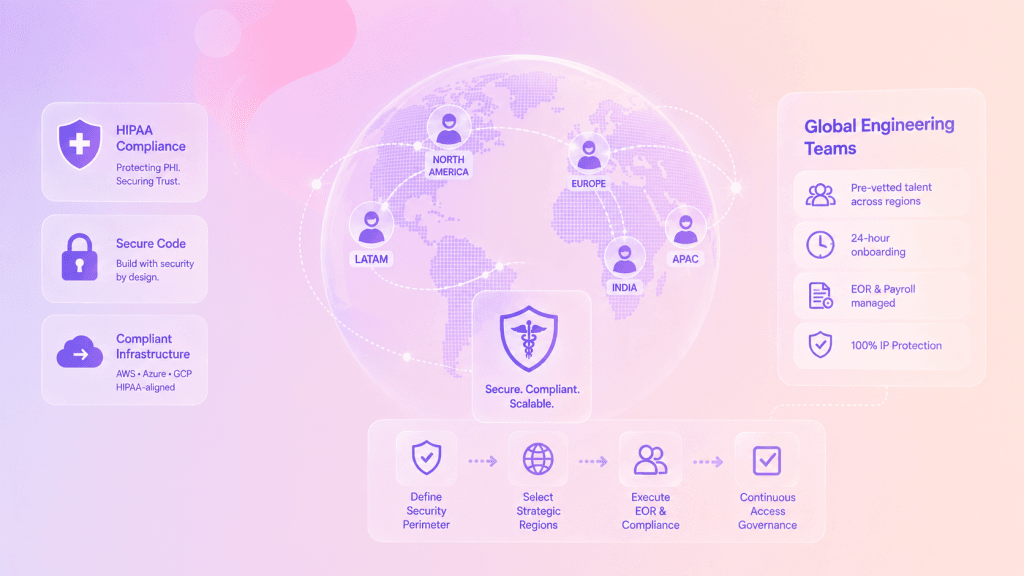
A common misconception among technical leaders is that international compliance is merely a legal matter, a signed Business Associate Agreement (BAA) or non-disclosure agreement. In practice, true HIPAA compliance at the engineering level is deeply operational. It dictates how your engineering workforce writes code, manages infrastructure, and handles data every single day.
When evaluating global software engineers for healthtech platforms, candidate capabilities must extend beyond standard tech stacks like React, Node, or Python to include three key operational pillars:
- PHI & Synthetic Data Hygiene: A clear understanding of Protected Health Information (PHI) segregation. Developers must know how to use synthetic or anonymized datasets in staging and local development environments so that real PHI never leaves secure production servers.
- Secure Coding & Zero-Trust Architecture: Experience building under strict access controls, implementing end-to-end encryption both in transit and at rest, and maintaining immutable audit logging.
- Compliant Infrastructure Standards: Familiarity with HIPAA-aligned configurations within major cloud providers (AWS, Azure, GCP), ensuring that serverless functions, databases, and API gateways meet regulatory standards by design.
The 4 Bottlenecks of Scaling Compliant Tech Teams Globally (And How to Unblock Them)
Expanding your engineering capacity across borders introduces operational drag if approached through traditional recruiting and entity-creation frameworks. Here is how modern technical leaders unblock the four most common friction points:
Bottleneck 1: Long Sourcing Cycles for Niche Healthtech Skills
Searching for senior software developers who simultaneously understand modern architecture and compliance protocols through local agencies can take anywhere from 60 to 90 days.
The Solution: Instead of starting candidate searches from scratch, leverage an established global talent partner with pre-vetted developer networks. Tapping into an existing ecosystem of pre-screened engineers across regions like LATAM and India allows you to fill critical skill gaps in as little as 24 hours.
Bottleneck 2: Physical & Endpoint Device Vulnerabilities
Remote environments inherently expand your attack surface. A lost, unencrypted laptop in another time zone can trigger a severe security breach and mandatory HIPAA disclosures.
The Solution: Mandate strict, centralized endpoint security before any global developer writes their first line of code:
- Enforce full-disk encryption and mandatory Multi-Factor Authentication (MFA).
- Deploy Zero Trust Network Access (ZTNA) and secure VPNs to restrict access strictly to authorized resources.
- Prohibit local storage of sensitive data, utilizing secure cloud workspaces or virtual desktop infrastructure (VDI) where necessary.
Bottleneck 3: Complex Legal, Tax, and Co-Employment Risks
Directly hiring international engineers means navigating localized labor laws, statutory benefits, cross-border tax withholding, and intellectual property (IP) assignments across multiple jurisdictions.
The Solution: Partner with a global talent provider that offers built-in Employer of Record (EOR) capabilities. An EOR acts as the legal employer in the developer’s home country, handling compliance, contracts, global payroll, and tax filings, while ensuring 100% of the IP generated is legally protected and transferred directly to your organization.
Bottleneck 4: Fragmented Onboarding & Loss of Velocity
Integrating remote international talent piecemeal often leads to misaligned security protocols, delayed tooling permissions, and sluggish sprint velocity during the first month.
The Solution: Standardize developer onboarding into a turnkey, repeatable process. Provide immediate, standardized security training and automated access controls on day one to eliminate downtime.
A Strategic Blueprint for Deploying Global HIPAA-Ready Talent
To scale your team cleanly without overextending internal HR or Legal operations, follow this four-step roadmap:
- Define Your Security Perimeter: Establish explicit boundaries for remote developer access. Enforce strict synthetic data policies for staging environments so developers never handle production PHI locally.
- Select Your Strategic Regions: Align global talent hubs with your operational goals. Utilize nearshore regions in LATAM for real-time collaborative sprints during North American business hours, and leverage offshore hubs in APAC or India to establish 24/7 “follow-the-sun” development cycles.
- Execute Turnkey EOR & Compliance Protocols: Offload global administrative burdens, such as international contracts, localized benefits, and co-employment liability, to a dedicated partner so your engineering management can focus entirely on code quality and product delivery.
- Implement Continuous Access Governance: Implement Role-Based Access Control (RBAC) across all code repositories and CI/CD pipelines. Conduct automated quarterly access reviews to immediately revoke credentials for offboarded resources or altered project roles.
Fast-Tracking Your Global Engineering Strategy
Scaling a healthtech platform does not require compromising on regulatory compliance or sacrificing product velocity to administrative bureaucracy. By combining global talent sourcing with robust Employer of Record capabilities, engineering leaders can expand their technical capacity safely and cost-effectively.
RapidBrains acts as a global talent partner with native EOR capabilities, giving healthtech scale-ups and enterprises instant access to a global talent pool of 500,000+ vetted software engineers across North America, LATAM, Europe, APAC, and India. Whether you need nearshore React talent or specialized cloud security engineers, RapidBrains helps you identify, onboard, and scale fully compliant engineering teams in as little as 24 hours.
Ready to scale your healthtech engineering capacity without compliance friction? Connect with a RapidBrains global talent expert today to discuss your technical hiring roadmap.