Most engineering leaders spend 90 percent of their vendor negotiation energy arguing over hourly or monthly developer rates, and less than 10 percent reading the contract clauses buried on pages four through seven.
That is an expensive mistake.
The hourly rate only tells you what an engineer costs while everything goes smoothly. The real financial risk sits in the engagement terms: minimum lock-in commitments, rigid auto-renewal windows, asymmetrical notice periods, and $20,000 to $50,000 conversion buyout penalties that trap you long after a sprint ends or a roadmap pivots.
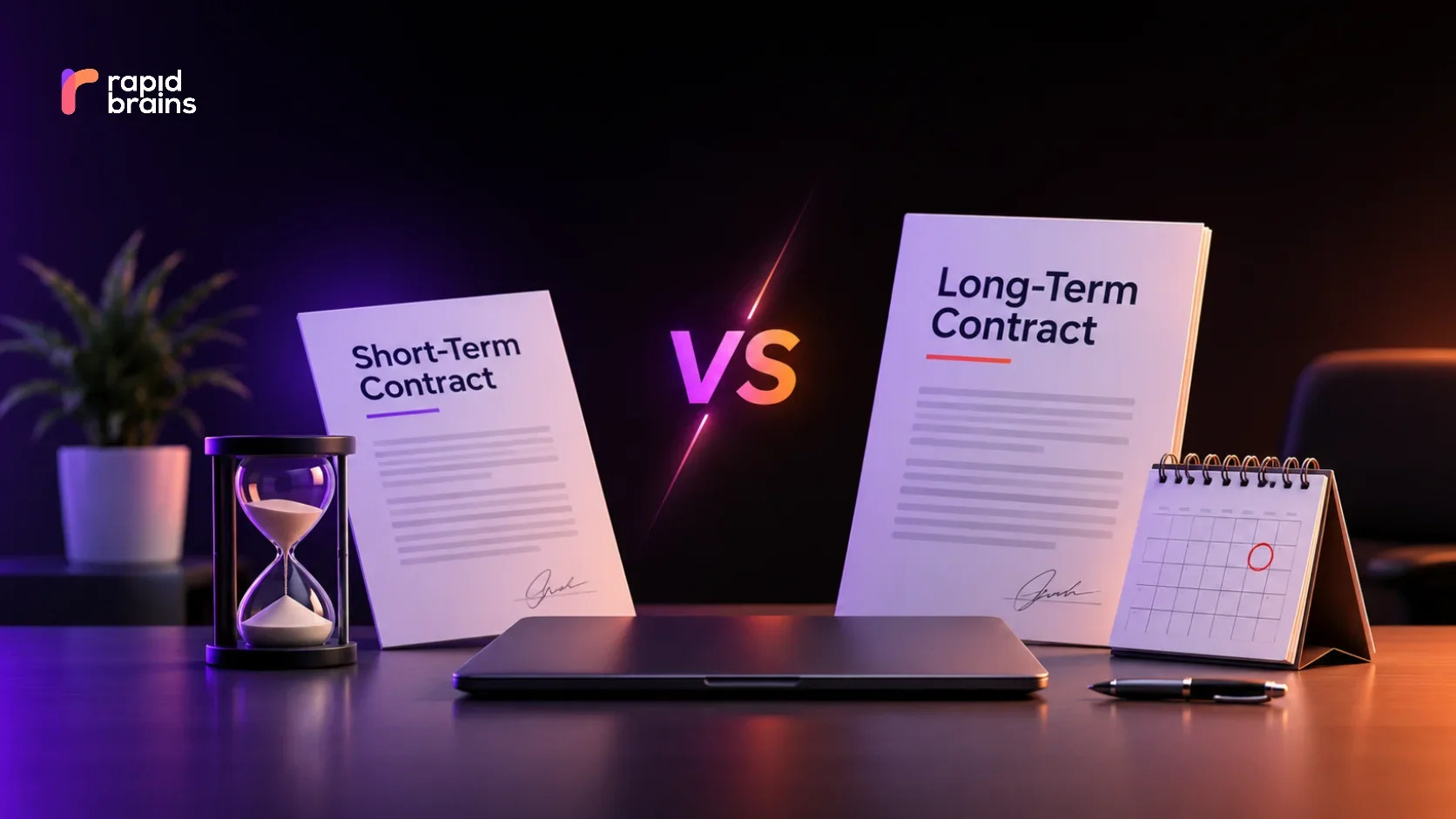
When scaling distributed engineering capacity, choosing between short-term and long-term contract developers is not just a staffing decision. It is a contract architecture decision. If you structure short-term engagements like permanent hires, you lose agility. If you run multi-quarter product roadmaps on loose, open-ended gig agreements, you invite sudden mid-sprint turnover and intellectual property exposure.
Here is how CTOs, VPs of Engineering, and technical founders can match engagement horizons to product needs, structure milestones, set balanced notice periods, and manage renewals without getting locked in.
Short-Term vs. Long-Term Contract Developers: Matching Horizon to Roadmap
Before drafting a Statement of Work (SOW), engineering leaders need to separate tactical sprint bursts from sustained product ownership. Both short-term and long-term contract developers have a clear place in modern engineering organizations, provided the contract mechanics match the work.
When Short-Term Contract Developers Make Sense (1 to 3 Months)
Short-term contracts are built for bounded, well-scoped technical deliverables where speed and specialized execution matter more than deep institutional product context
-
Targeted Feature Builds and Integrations: Implementing a specific third-party API, payment gateway, or compliance module on a fixed deadline.
-
Infrastructure Migrations and Audits: Moving workloads across cloud providers, upgrading legacy frameworks, or running pre-launch security and performance hardening.
-
Rapid Prototyping and Proof of Concepts: Validating an AI workflow or new product vertical before committing permanent roadmap budget.
-
Immediate Bottleneck Relief: Covering parental leave or bridging a sudden gap while permanent hiring pipelines catch up.
The primary risk with short-term contracts is over-committing to rigid minimums. Some staffing vendors quietly insert three-month minimum engagement floors or steep early-termination fees even for six-week sprints.
When Long-Term Contract Developers Make Sense (6 to 18+ Months)
Long-term contract engagements are designed for ongoing product development, core platform architecture, and sustained team velocity. Unlike short-term task execution, these developers embed directly into your Slack channels, daily standups, and CI/CD pipelines as full-time contributors.
-
Core Product Squad Expansion: Adding dedicated frontend, backend, or mobile capacity to accelerate multi-quarter feature roadmaps.
-
Specialized Domain Ownership: Retaining senior DevOps, MLOps, data engineering, or cybersecurity specialists who maintain living production systems.
-
Capital-Efficient Scaling: Blending a lean internal leadership core with dedicated global contract developers to extend runway without permanent entity overhead.
-
Contract-to-Hire Evaluation: Observing how a developer handles real production incidents, code reviews, and cross-functional communication over two quarters before making a permanent offer.
The primary risk with long-term contracts is accidental lock-in. Annual auto-renewal clauses, 60-to-90-day exit windows, and punitive conversion fees can turn a flexible staffing arrangement into a fixed liability.
Side-by-Side Comparison: Short-Term vs. Long-Term Engagement Structures
|
Contract Dimension |
Short-Term Engagement (1 to 3 Months) |
Long-Term Engagement (6 to 18+ Months) |
|
Primary Goal |
Bounded deliverables, migrations, audits, or acute sprint relief. |
Ongoing product velocity, system ownership, and roadmap execution. |
|
Billing & Scope Structure |
Milestone-based SOW or capped monthly sprint blocks. |
Predictable flat monthly retainer for 100% full-time dedication. |
|
Ideal Notice Period |
7 to 14 calendar days mutual notice. |
30 calendar days mutual notice (14 days during initial trial). |
|
Renewal Mechanism |
Explicit written extension only; no automatic rollover. |
Month-to-month evergreen continuation after initial term. |
|
Knowledge Transfer |
Mandatory documented handoff tied to final milestone acceptance. |
Continuous documentation, pair programming, and shared repository ownership. |
|
Buyout / Conversion Terms |
Typically not applicable; zero lock-in after SOW completion. |
Pre-negotiated, transparent conversion window with zero or declining fees. |
1. Structuring Milestones That Drive Delivery Without Rigidity
How you structure milestones determines whether your contract developers ship working software or spend half their week negotiating scope changes.
For Short-Term Engagements: Tie Payments to Objective Acceptance Criteria
In one-to-three-month engagements, vague hourly estimates create budget runaway, while overly rigid waterfall specs stall iteration. Structure short-term SOWs around two-week sprint milestones paired with clear, binary acceptance criteria:
-
Define Done in Engineering Terms: Specify passing unit and integration tests, merged pull requests in staging, updated API documentation, and zero critical security vulnerabilities rather than subjective visual sign-offs.
-
Use Balanced Payment Splits: Avoid paying 100 percent upfront. A practical structure allocates 20 to 30 percent upon kickoff, 40 to 50 percent across mid-project sprint checkpoints, and 20 to 30 percent upon final deployment and handoff.
-
Include a Short Warranty or Stabilization Buffer: Keep 5 to 10 percent of the final milestone tied to a 14-to-30-day post-deployment stabilization window so bugs discovered in production are fixed promptly.
For Long-Term Engagements: Use Quarterly Outcome Checkpoints
For six-to-eighteen-month dedicated developers, billing per individual ticket creates administrative friction and discourages developers from refactoring technical debt or helping teammates. Instead, pair a predictable monthly engagement rate with structured 90-day architectural checkpoints:
-
30-Day Onboarding & Velocity Gate: Confirm environment access, first production pull requests merged, and smooth communication cadence within your engineering rituals.
-
90-Day Architectural Review: Evaluate code quality, system ownership, sprint predictability, and collaboration before rolling forward into the next quarter.
-
Rolling Backlog Prioritization: Retain full unilateral authority to reprioritize sprint backlogs every two weeks without triggering contract amendments or change-order fees.
2. Designing Fair, Balanced Notice Periods
Notice periods exist to protect continuity on both sides: giving you time to transition codebase ownership if a developer exits, and giving the developer reasonable income predictability if project budgets shift. Problems arise when notice windows are copied blindly from traditional enterprise employment contracts.
In many global tech hubs, standard permanent employment contracts carry 60-to-90-day notice periods. Applying a 90-day notice clause to a flexible contract developer defeats the entire purpose of agile staffing. Conversely, zero-notice freelance arrangements leave your sprint exposed if an engineer disappears overnight.
Follow four rules to keep notice periods practical:
-
Keep Notice Periods Mutual: Ensure the exact same notice window applies whether your company scales down or the developer requests a release. Asymmetrical clauses that lock you in for 60 days while allowing the vendor to swap talent on 5 days' notice shift all operational risk onto your team.
-
Include a 14-to-30-Day Initial Trial Window: Even after rigorous technical interviews, real-world team chemistry shows up in the first two weeks. Include an initial evaluation period with a 7-to-14-day exit or free replacement guarantee if technical execution falls short.
-
Right-Size Post-Trial Notice to Tenure: Use 14 calendar days for short-term contracts under three months, and 30 calendar days for long-term dedicated engineers. Thirty days covers two full two-week sprints, which is plenty of time to complete documentation and transition active pull requests.
-
Tie Final Offboarding to Knowledge Transfer: Make the final two weeks of any notice period explicitly conditional on completing a structured handover checklist: runbook updates, environment credential transfers, architectural walkthroughs, and open pull request resolution.
3. Eliminating Lock-In in Renewals and Conversion Clauses
The sneakiest forms of vendor lock-in rarely appear in the initial Master Services Agreement (MSA). They hide in renewal mechanics and non-solicitation language.
Kill Multi-Month Auto-Renewals
Never sign a contract staffing agreement that automatically renews for another six-month or twelve-month term unless you cancel 60 days in advance. If a product pivot happens 45 days before the deadline, you end up paying for unused engineering capacity.
Instead, structure renewals to convert automatically to a month-to-month cadence after any initial commitment period, governed by your standard 30-day mutual notice window. If you want to lock in volume rate discounts for a full year, trade rate stability for a simple termination-for-convenience clause with 30 days' notice rather than an inflexible cash commitment.
Watch Out for Punitive Buyout and Non-Solicitation Traps
Many legacy staffing agencies and high-markup talent networks treat their developer pool like a walled garden. Industry data shows that published conversion buyout fees frequently range from $20,000 to $50,000 per engineer, sometimes extending 12 to 24 months after the engagement ends.
Before signing any contract, clarify three terms in writing:
-
Explicit Conversion Path: If an engineer becomes indispensable to your architecture over 12 months, can you hire them full-time, and what is the exact fee schedule?
-
Time-Decaying Conversion Fees: Any fair placement or conversion fee should decrease linearly with tenure (for example, stepping down at 6 months and dropping to zero after 12 months of continuous billing) rather than charging a flat $50,000 penalty forever.
-
Watertight IP Assignment From Day One: Regardless of whether an engagement lasts six weeks or two years, verify that all source code, architectural diagrams, tests, and documentation vest immediately in your company upon creation, backed by locally enforceable invention assignment agreements.
How RapidBrains Structures Flexible Engineering Engagements
Building an elastic engineering organization should not require your legal team to spend weeks redlining predatory staffing contracts.
RapidBrains designs every engagement around transparency, technical rigor, and zero lock-in:
-
Pre-Vetted Talent Deployed in Days: Every developer in the RapidBrains network passes multi-stage coding, system design, and communication assessments before reaching your shortlist, compressing hiring timelines from months to days.
-
Flexible Horizons With Zero Arbitrary Lock-In: Whether you need a specialized engineer for a targeted three-month sprint or a dedicated full-stack pod for multi-year product development, agreements transition smoothly on predictable monthly terms with straightforward 30-day notice.
-
Built-In Global Compliance and IP Protection: RapidBrains manages local employment contracts, payroll, statutory benefits, and jurisdiction-specific IP assignment across global tech hubs, eliminating contractor misclassification risks and cross-border legal overhead.
-
Seamless Replacement Guarantees: If a developer is not the right technical or cultural fit during onboarding, RapidBrains provides a rapid, pre-vetted replacement so your sprint velocity never stalls.
Great engineering contracts do not rely on legal handcuffs to keep clients around. They rely on consistent shipping velocity, clean code, and mutual flexibility. When your milestones, notice periods, and renewal terms are built for agility, you gain the freedom to scale your engineering team up or down at the exact speed your roadmap demands.